
How does GPS fuel monitoring reduce fleet costs? It’s a question more fleet managers are asking as fuel prices squeeze operating margins. Fuel is the single largest variable expense in any commercial fleet budget, typically consuming 20, 30% of total operating costs for long-haul trucking operations. Most fleet managers know the number is high. What they don’t know is how much of it is preventable. At Easy Track, working with transport and logistics operators across East Africa, we see the same reaction repeatedly: once a GPS fuel monitoring system goes live, managers discover that a significant share of their fuel spend was leaking out through idling, theft, and route inefficiency the entire time, often in the range of 15, 25%, based on what we observe across customer deployments.
This article breaks down exactly how GPS fuel monitoring reduces fleet costs. Not a list of vague benefits, but the specific mechanisms: tank-level sensors, idle detection, route optimization, and driver behavior coaching. Each section includes documented savings data so you can estimate what your fleet stands to recover before you spend a dollar on a new system.
Why fleet fuel costs run higher than most managers think
The problem with fuel waste is that it’s invisible without the right tools. Idling hours accumulate quietly while drivers wait at loading docks or sit in traffic with the engine running. Fuel theft doesn’t appear on receipts as anything other than “fuel purchased.” Inefficient routing doesn’t generate a complaint from customers; it just burns extra diesel that gets absorbed into the monthly expense total. The waste is real. It just never shows up in any report you can generate without telematics data.
Industry estimates place recoverable fuel waste in a typical unmonitored commercial fleet at 15, 25% of total fuel spend, though the actual figure varies by fleet size, region, and operating conditions. For a 25-truck fleet spending $10,000 per month on fuel, that’s $1,500 to $2,500 per month distributed across four categories: unauthorized idling, unauthorized use, theft or siphoning, and route inefficiency. Each of those categories has a specific GPS monitoring mechanism that addresses it directly. Here’s how each one works.
How GPS fuel monitoring reduces theft and fraud: fuel level sensors and real-time alerts
The foundation of any serious fuel tracking telematics setup is a tank-level sensor. Capacitive sensors, the preferred technology for fleet fuel management, are installed directly in the fuel tank and transmit continuous level readings to the fleet management platform. These sensors achieve measurement accuracy of ±0.5% to ±1% of full scale, which means they can detect a change of 1, 2 liters in a standard 400-liter tank in near real-time. That level of precision is what separates genuine theft from normal consumption variation.
The alert logic works on two triggers: a sudden drop exceeding 3, 5% of tank capacity without the vehicle being at an authorized fueling station, or a drainage rate exceeding approximately 150ml per minute. When either threshold is crossed, the system fires an alert within 3, 5 seconds, with a GPS coordinate and timestamp attached. The fleet manager knows exactly where the vehicle was and at what time the anomaly occurred, not the next morning during a report review, but while it’s happening.
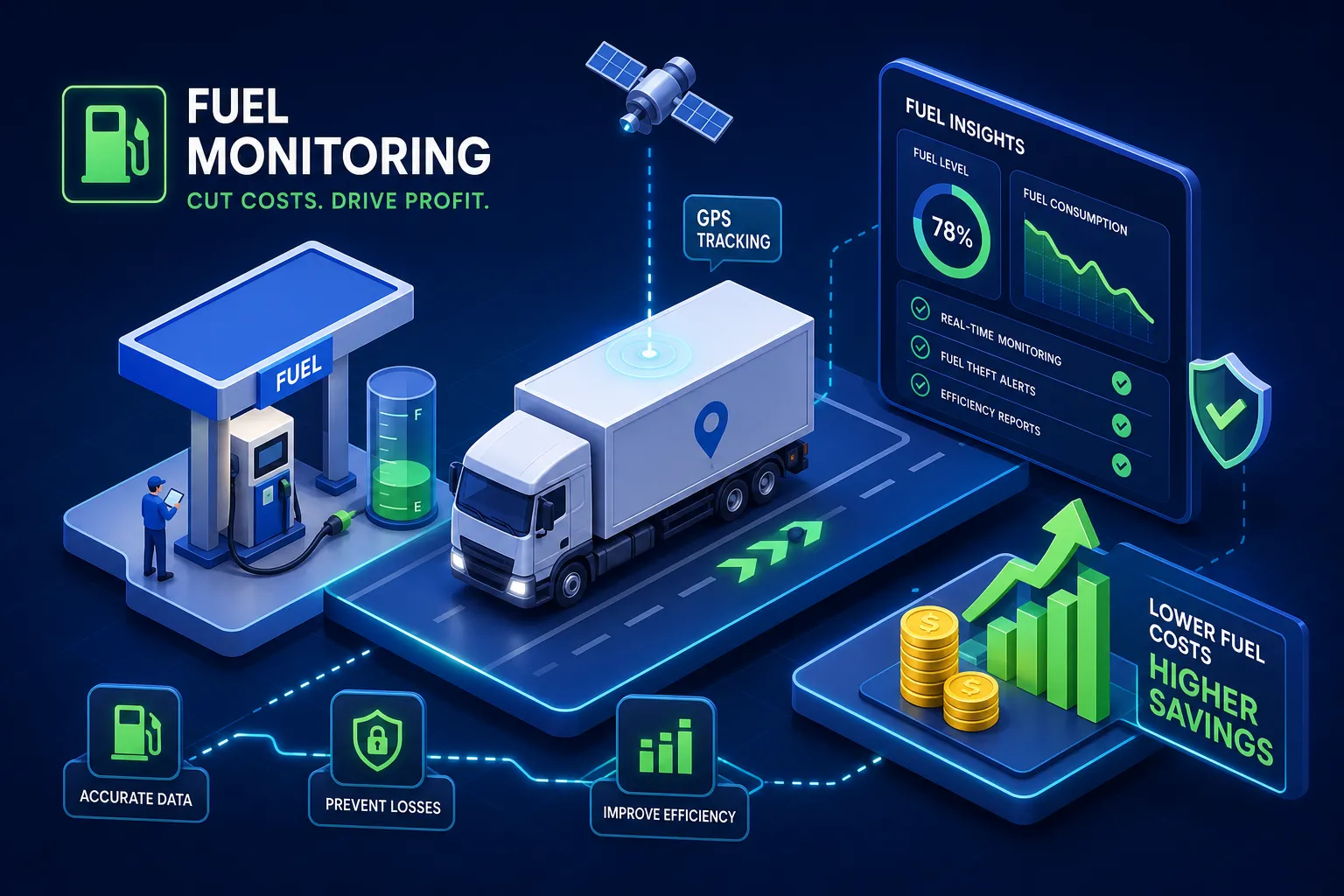
Easy Track’s fuel monitoring system integrates capacitive tank sensors with real-time GPS data, giving fleet managers a consumption timeline mapped against vehicle location. That combination is what makes the data actionable. You’re not just seeing a fuel level; you’re seeing the full context of when, where, and how fast the fuel disappeared. One documented logistics deployment using this setup recorded a 70% reduction in fuel theft incidents within three months of going live. For high-value cargo routes or long-haul cross-border operations, that’s a meaningful recovery on its own.
How GPS fuel monitoring reduces idle costs: idle-time detection
Idling is the most underestimated source of fuel waste in commercial trucking. A diesel engine burning at idle consumes approximately 0.8 to 1.0 gallons per hour depending on engine size and load. For a fleet of 25 trucks averaging 90 minutes of idle time per shift, using a burn rate of roughly 0.8 gallons per hour, that adds up to approximately 30 gallons per day in fuel burned with zero transport value. Multiply that across a month and you’re looking at a significant expense line that doesn’t appear anywhere labeled “wasted fuel.”
Idle-time monitoring works by detecting engine-on with vehicle stationary, logging the duration, and triggering alerts after a configurable idle threshold is reached. Those alerts go to the driver in-cab and to the fleet manager on a mobile dashboard simultaneously. The critical difference between this and a weekly idle report is timing: the correction happens in the moment. Next week’s debrief means the driver has no memory of the specific event. Real-time alerts close that gap.
Fleets using idle alerts and structured idle reporting have reduced idle time by up to 40%, with fuel savings of 3, 8% of total fleet fuel spend from idle reduction alone. Geo-fencing adds another layer here, preventing vehicles from operating in unauthorized zones or outside approved hours. That combination eliminates after-hours idling and unauthorized trips, contributing up to an additional 5% in fuel savings. Together, idle detection and geo-fencing address a category of waste that most fleets are carrying without realizing it.
Route optimization and driver behavior coaching
GPS-based route optimization does more than pick the shortest path. A mature fleet telematics platform factors in historical traffic patterns, road conditions, and actual fuel consumption efficiency to minimize burn per delivery. For long-haul trucking operations, optimized routing has delivered 10, 15% fuel savings beyond what behavioral changes alone achieve, a range supported by fleet telematics deployments across multiple industries. The system also tracks actual route adherence against planned routes, so unauthorized detours surface as data rather than suspicion. When a deviation is flagged, managers receive an alert with location and timestamp, and the event is logged on the driver’s scorecard for follow-up.
Driver scorecards are where fuel consumption tracking turns behavioral data into sustained fuel economy improvements. These platforms score drivers on smooth acceleration, consistent speed, minimal idling, and braking behavior, weighting each metric based on its correlation with fuel consumption and accident risk. Speeding, for example, typically carries a 25, 35% weight in a composite score because it has the strongest correlation with both fuel waste and collision risk. Harsh braking gets a high weight because it indicates reactive driving rather than anticipatory driving, which burns significantly more fuel.
Scorecard-driven coaching programs deliver measurable results: 6, 12% reduction in fuel spend and up to 30% fewer harsh braking and rapid acceleration incidents in fleets that pair scorecards with structured weekly coaching sessions. The programs that deliver the highest savings combine real-time in-cab alerts with weekly one-on-one coaching and non-punitive incentives like leaderboards and public recognition. In-cab alerts, audio or visual, fire at the moment of the behavior, which is when correction is most effective. Penalties alone don’t produce sustained behavior change. Data, coaching, and recognition do.
Calculating your fleet’s realistic ROI
The savings data from documented deployments is specific enough to build a meaningful estimate before you commit to a system. Consider a 10-vehicle fleet spending $3,000 per month on fuel. At a 12% savings rate, a conservative starting point based on average fleet inefficiency levels, that works out to $360 per month in recovered fuel costs. After a typical GPS subscription cost of around $25 per vehicle per month ($250 total), net savings land at approximately $110 per month, or around $1,320 per year for a 10-vehicle operation. Fleets with higher baseline inefficiency, or higher fuel spend, will see proportionally larger returns.
The large-scale case study that provides the most granular vehicle-type data tracked over 5,300 vehicles across five industries in two Latin American markets. Average fuel savings ranged from 8.1% to 10.0% per vehicle, translating to $115 to $125 in savings per vehicle per month. Scaled to a 100-truck fleet, the annual savings from combined idle reduction, theft prevention, route optimization, and driver coaching reach approximately $330,000. The savings breakdown across those categories looks like this:
- Idle reduction: approximately $90,000 per year for a 100-truck fleet
- Theft and fraud prevention: approximately $65,000 per year
- Route optimization: approximately $80,000 per year
- Driver behavior coaching: approximately $55,000 per year
Payback periods for most fleets fall within 6, 12 months. Fleets with significant idle time and theft problems at baseline frequently achieve positive ROI within 90 days. The fastest payback cases focus on idle alerts and theft detection first, let those deliver savings in the first 60 days, and then layer in route optimization and driver scorecards as the team builds familiarity with the platform.
When evaluating a GPS fuel monitoring system, prioritize these specific capabilities:
- Real-time tank-level sensors (not software estimates based on mileage)
- GPS-correlated alerts with timestamp and location
- Idle-time reports with driver-level detail rather than fleet-level summaries
- Route optimization integration that tracks planned versus actual routes
- Driver scorecard dashboards with configurable metric weighting
Before piloting anything, pull 90 days of current fuel receipts, calculate your average monthly fuel spend per vehicle, and apply a conservative 12% savings rate to that number. That single calculation usually makes the ROI case without needing any additional data.
The bottom line on GPS fuel monitoring and fleet fuel savings
Understanding how GPS fuel monitoring reduces fleet costs comes down to four mechanisms working at different points in the fuel loss chain. Tank sensors stop theft and siphoning losses at the source. Idle detection cuts the engine-on burn that accumulates quietly across every shift. Route optimization removes unnecessary mileage before the trip starts. Driver coaching turns behavioral data into sustained fuel economy improvements that compound over time. Together, these mechanisms typically deliver 10, 20% fuel cost reductions for GPS telematics deployments, with integrated systems reaching 18, 25% for fleets that had significant inefficiency baked in before monitoring started.
If you’re at the evaluation stage, start with your fleet’s current fuel spend per vehicle per month and apply a 12% savings estimate to get a conservative baseline. For most commercial fleets, that number alone closes the ROI conversation. For fleets operating across East Africa or managing cross-border logistics routes through Tanzania, Easy Track’s fleet fuel management solution is built around exactly these mechanisms: capacitive tank sensors, real-time GPS-correlated alerts, idle tracking, and driver behavior dashboards designed for the operational demands of regional commercial transport. Reach out to the Easy Track team to map the specific features against your fleet’s current cost structure and get a realistic savings estimate for your operation.

 By
By