
How can GPS tracking reduce my fleet operating costs? It’s one of the most common questions fleet managers ask, and the answer isn’t a single line item. Fleet operating costs are one of the hardest expense categories to control because the waste is invisible until it compounds. Fuel drains through idling engines, maintenance budgets erode after preventable breakdowns, and insurance premiums stay elevated in part because insurers lack the operational data to justify discounts. Most fleet managers know they’re losing money somewhere; they just can’t pinpoint exactly where.
GPS fleet tracking changes this by turning every kilometer, every engine-on minute, and every harsh braking event into a data point your team can act on. Platforms like Easy Track, which provides real-time fuel monitoring and fleet ERP analytics for transport operators across East Africa, are built around exactly this problem: giving fleet managers the visibility to find and eliminate unnecessary costs across their entire operation.
Here are eight specific mechanisms that drive those savings, backed by real numbers, so you can build a grounded business case before making any purchasing decision.
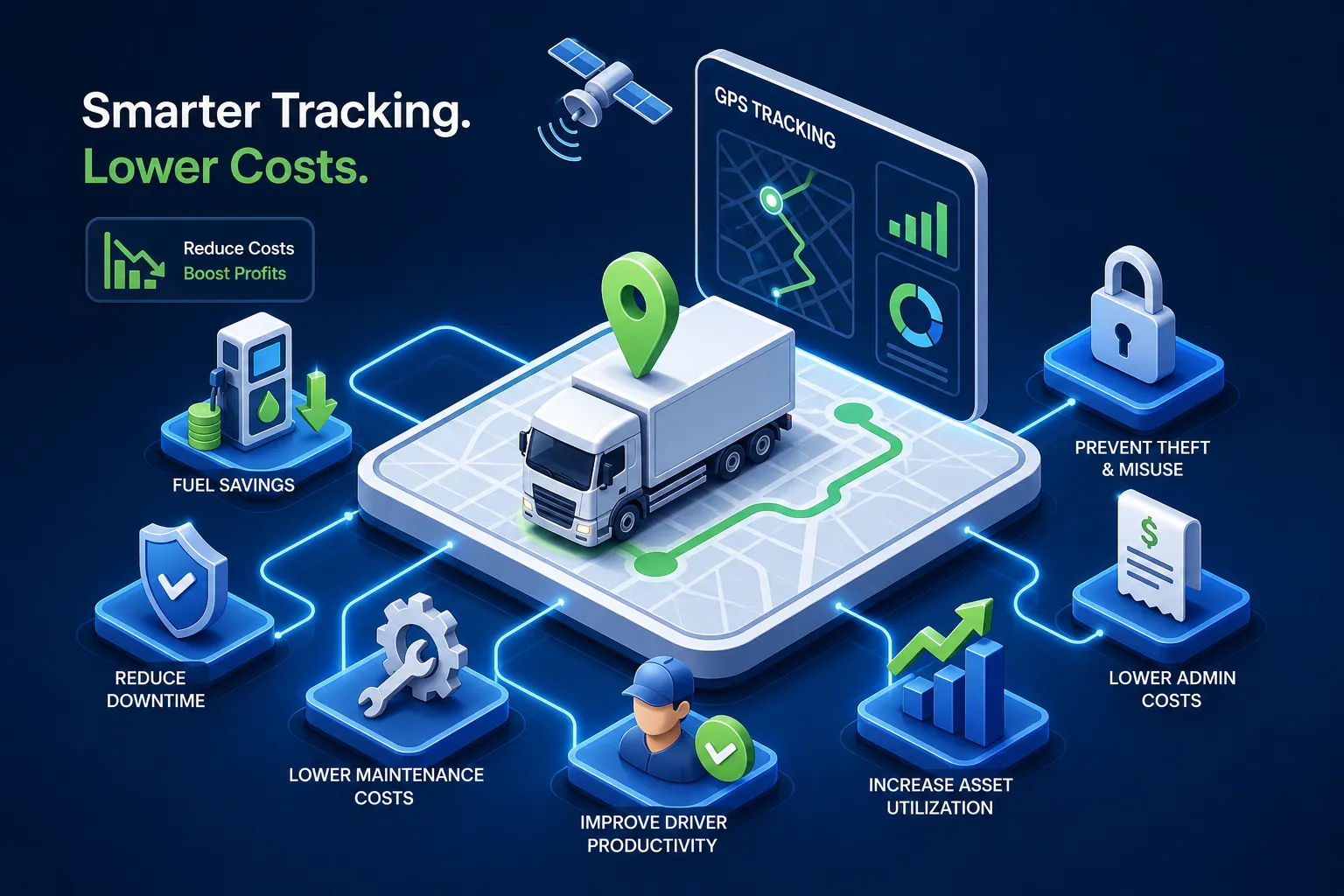
1. GPS fuel monitoring closes the gaps draining your budget
Fuel is the largest single controllable cost for most fleets. Industry data regularly places fuel in the range of 25, 40% of total operating expenses, making it the highest-leverage target for any cost-reduction program. Without real-time visibility into fuel levels and consumption rates, losses from theft, unauthorized refueling, and driver inefficiency are nearly impossible to detect on a standard invoice.
How real-time fuel sensors expose theft before it accumulates
GPS-integrated fuel sensors create a live data trail of fuel levels matched against trip distance. When a vehicle’s fuel level drops faster than the distance driven can justify, the system flags it immediately. Without this capability, fleet managers often discover theft weeks later during reconciliation, by which point the loss is already significant. Easy Track’s real-time fuel monitoring gives transport operators this visibility before losses compound. Industry analyses of telematics deployments report an average 10, 15% reduction in fuel costs after implementation, with fleets correcting significant pre-existing inefficiencies reporting reductions of up to 25%.
Idle time: the hidden fuel drain most managers ignore
A commercial truck burns 0.5, 1 gallon of fuel per hour while idling. Across a 30-vehicle fleet running two hours of unnecessary idle per day, that works out to roughly $10,950, $21,900 in wasted fuel annually at $1.00, $2.00 per gallon, before factoring in accelerated engine wear. Telematics systems generate idle time reports that fleet managers use to set policies, monitor compliance, and coach drivers. Verizon Connect’s 2026 fleet data found up to a 15.9% reduction in idling after telematics deployment, which translates directly into fuel savings without requiring any change to routes or loads.
2. How GPS tracking reduces fleet operating costs through route optimization
There’s an important distinction between navigation and route optimization. Navigation tells a driver where to go. Route optimization tells a dispatcher which routes minimize distance, fuel, and drive time across the entire fleet simultaneously, prior to dispatch.
Fewer kilometers driven, lower costs per trip
Studies show that 10, 20% of total fleet distance is unnecessary, driven by suboptimal routing, poor load planning, or manual dispatch decisions. Route optimization software addresses this by calculating efficient multi-stop routes from the start. For fleets with significant routing inefficiencies, the fuel impact alone averages 20, 30% annually, and those savings compound into lower maintenance costs, reduced tire wear, and fewer driver hours paid.
The multiplier effect of smarter dispatch
Route savings don’t stop at fuel. Every kilometer eliminated also reduces vehicle wear, tire consumption, and the probability of a breakdown on the road. Fleets that pair route optimization with GPS tracking often see secondary savings that exceed the initial fuel reduction, especially when assets are running multiple shifts per day.
3. Driver behavior monitoring: the metrics that actually move the cost needle
The cost difference between your best and worst drivers can reach 15, 20% in fuel consumption alone, before accounting for maintenance and accident risk. GPS telematics systems make this gap visible, and, more importantly, fixable.
Aggressive driving by the numbers
The research on specific behaviors is precise enough to build a real business case. These are the correlations that matter most:
- Aggressive driving (rapid acceleration, harsh braking) increases fuel costs by up to 33% per vehicle
- Speeding 10 mph over the limit raises fuel consumption by 14%
- Harsh braking increases tire wear costs by 73% compared to cautious driving
- Maximum throttle events raise annual maintenance costs by up to 160%
Telematics systems score drivers on these behaviors in real time, giving fleet managers the data to identify their highest-cost drivers quickly and consistently.
Turning driver scorecards into dollar savings
When behavior data is shared with drivers and improvement targets are set, the outcomes are measurable. According to fleet telematics industry benchmarks, correcting aggressive driving alone saves approximately $3,200 per vehicle per year. Improving the worst-performing drivers to average behavior levels saves $450 or more per vehicle annually, with the majority of that value coming from reduced crash costs and maintenance rather than fuel savings alone.
4. Maintenance scheduling through telematics: fix problems before they break you
Reactive maintenance means fixing breakdowns as they happen. Telematics-driven maintenance scheduling means servicing vehicles based on actual engine data, mileage, and fault codes, before something fails. The cost difference between these two approaches is the core financial argument for this section.
What predictive alerts actually prevent
Telematics systems monitor engine diagnostics, mileage thresholds, and component health continuously. When fault codes appear or service intervals approach, the system triggers an alert so the vehicle gets scheduled before it fails on the road. McKinsey research cites a 10, 40% reduction in maintenance costs through predictive approaches, while 2025 industry data shows up to 45% less unplanned downtime. For a 50-vehicle fleet, eliminating two breakdowns per month at $800 each saves $19,200 annually.
The true cost of an unplanned breakdown
An unplanned breakdown on the road carries costs well beyond the repair bill: roadside assistance, towing, emergency labor premiums, missed delivery penalties, and replacement vehicle expenses. Emergency repairs average $8,500, $12,000 per incident. Telematics-enabled predictive maintenance, where fault codes and component health data drive service scheduling, generates $3,800 or more in annual savings per vehicle, with some fleet implementations reporting 550, 650% ROI on maintenance management programs of this type.
5. Insurance discounts and compliance savings most fleet managers overlook
Insurance premiums feel like a fixed cost. For most fleets, they’re not. Telematics data is one of the most practical levers for renegotiating commercial premiums at renewal, and the majority of fleet managers never use it.
What telematics data does to your premium at renewal
Commercial fleets typically receive a 5, 15% discount for installing approved GPS devices, with an additional 5, 25% performance-based reduction at renewal after 6, 12 months of documented safe driving data. Combined, well-managed fleets can achieve 10, 25% total first-year savings, with some carriers offering up to 40% reduction for comprehensive telematics data sharing. The mechanism is straightforward: insurers price risk, and telematics reduces their uncertainty about how your fleet actually operates. The key action is proactively sharing driver behavior data with your insurer at every renewal conversation.
Regulatory compliance as cost avoidance, not overhead
For transport operators in regulated markets, compliance is not optional. GPS systems help fleets avoid fines, permit delays, and route violations by keeping documentation current and flagging non-compliant behavior before it becomes a penalty. For operators in East Africa, this is especially relevant: Easy Track’s platform is built to support compliance with local regulatory requirements, including Electronic Cargo Tracking Seal (ECTS) and Vehicle Tracking System (VTS) standards, so compliance documentation is managed within the tracking system rather than as a separate administrative process.
6. When will you actually see ROI? A realistic timeline by fleet size
The most practical question before any technology adoption is simple: how long before this pays for itself? For GPS fleet tracking, the answer depends on fleet size, current inefficiency levels, and which cost categories have the most room for improvement.
Payback periods by fleet size
Fleet telematics ROI data from logistics and transport operators points to consistent patterns. Small fleets of 1, 10 vehicles typically see a 4, 6 month payback period. Mid-size fleets of 11, 50 vehicles average 3, 5 months. Large fleets with 50 or more vehicles recover their investment in 2, 4 months, while enterprise fleets above 500 vehicles often break even in 1, 3 months due to economies of scale. Across all categories, 71% of fleets recover their investment within 12 months, and 47% see positive ROI in under 6 months. Fleets with the most pre-existing inefficiencies, high idle time, poor routing, and no formal maintenance schedules, tend to see the fastest returns.
The five KPIs to track in your first 90 days
Set benchmarks on day one and measure these monthly. They tell you whether your telematics solution is delivering and give you the data to calculate vehicle tracking savings in concrete dollar terms at your 90-day review:
- Fuel consumption per kilometer
- Idle time percentage across the fleet
- Average route deviation from planned distance
- Maintenance cost per vehicle per month
- Driver behavior score average
These five metrics cover the primary cost categories that GPS tracking affects. If they’re trending in the right direction after 90 days, your 90-day data becomes the business case, no additional modeling required.
The compounding case: how GPS tracking reduces fleet operating costs across every line item
GPS tracking reduces fleet operating costs not through one mechanism but through six or seven working simultaneously: fuel efficiency, idle reduction, route optimization, driver behavior improvement, maintenance scheduling, insurance discounts, and compliance cost avoidance. Fuel savings fund the system in months. Maintenance savings extend vehicle life by years. Insurance discounts compound at every renewal cycle. The combined effect is a cost structure that improves quarter over quarter rather than one that demands constant manual firefighting.
The practical starting point is an audit: where are your fleet’s biggest waste categories right now? Fuel, maintenance, driver behavior, or route efficiency? That’s where your fastest fleet telematics ROI will come from, and that’s the number worth building a business case around before you evaluate any platform.
For transport operators looking for a proven starting point, Easy Track’s real-time fuel monitoring and fleet ERP analytics are built specifically to surface these inefficiencies and give you the data to act on them. Ready to see how GPS tracking can reduce your fleet operating costs? Easy Track’s team can run an efficiency audit against your current cost data, that’s the fastest way to put a real number on what your fleet is losing.

 By
By