
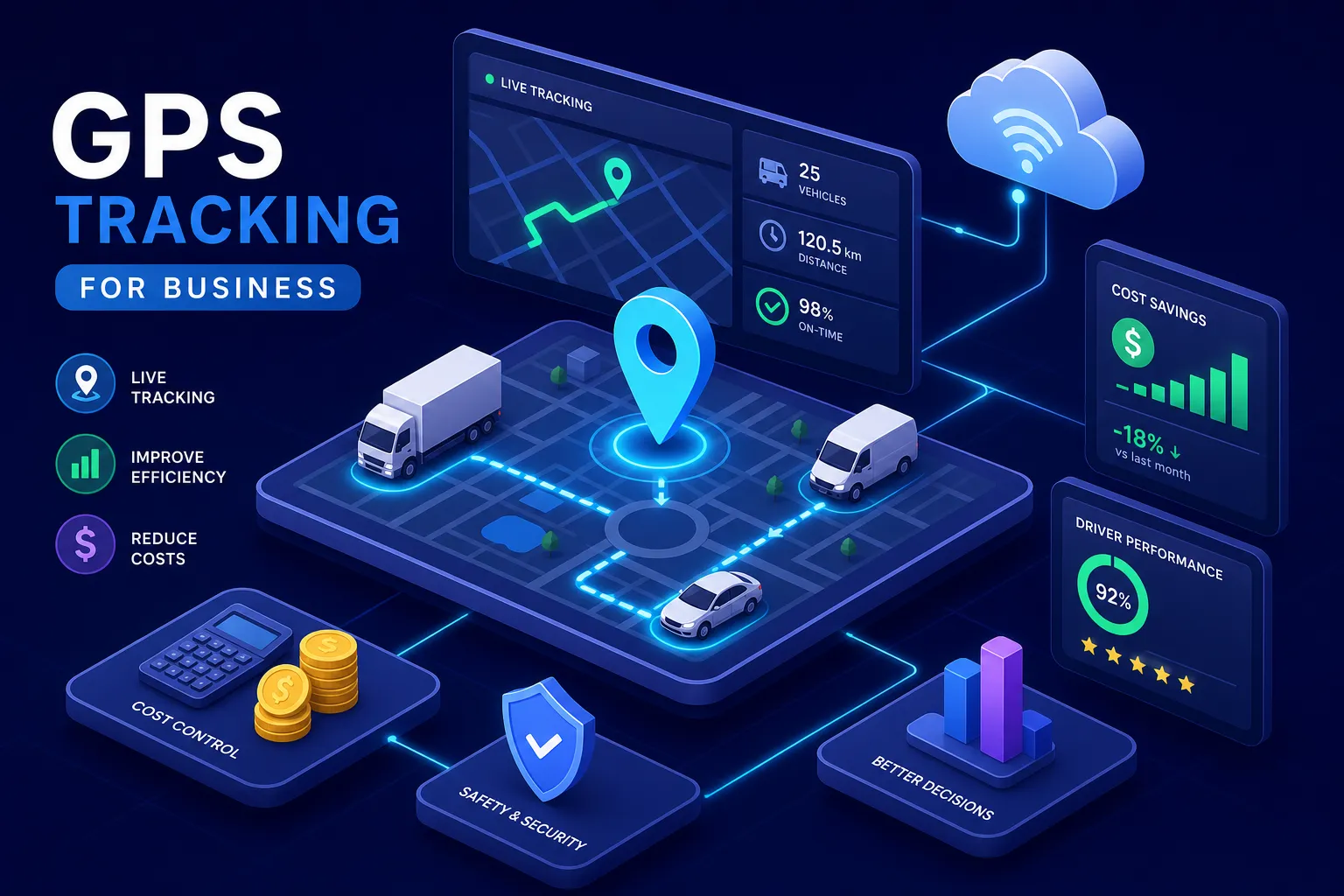
Most businesses that start looking into GPS tracking for business operations already know something is wrong. Fuel costs are climbing. A driver’s timecard doesn’t match the route history. A piece of equipment went missing from a job site last quarter. The problem is obvious. The solution, buried under vendor marketing and feature lists that sound identical, is not.
Commercial vehicle tracking has moved well past a blinking dot on a map. Modern telematics solutions cover real-time vehicle tracking, cargo security, portable asset tracking, fuel monitoring, and full fleet management ERP software that ties location data to dispatch, payroll, and maintenance in one place. Logistics companies use it to cut fuel costs. Mining operations use it to account for equipment in remote fields. Enterprise fleets use it to hold drivers accountable without micromanaging every shift.
At Easy Track, we build tracking systems around how a business actually operates, not around a generic hardware bundle. That perspective shapes how we think about what a good solution looks like versus what just looks good in a product demo. This article gives you the feature breakdown, real cost numbers, and a framework for shortlisting providers that fit your operation.
GPS tracking for business: what it actually delivers
Real-time location and what it changes day-to-day
Real-time vehicle tracking does three things that immediately affect your bottom line: it enables closest-vehicle dispatch so you stop sending a truck from across town when one is three blocks away, it surfaces idle time the moment it’s happening instead of after the fact, and it lets managers make route adjustments mid-shift rather than discovering the detour at end of day. None of that is possible with a system that updates every few minutes.
The numbers behind this are specific. Fleets using real-time tracking see an average 16% reduction in fuel costs from idle reduction alone. A 10-vehicle fleet that verifies timecards through GPS location history recovers more than $22,000 in unproductive labor annually, based on consistent outcomes from active deployments across logistics and service fleets. Those aren’t projections, they’re results businesses are seeing on the ground.
Driver behavior monitoring and the insurance payoff
Telematics-driven driver scorecards track speeding, harsh braking, and aggressive acceleration. That data does two things: it reduces accident costs by roughly 22% and qualifies fleets for insurance premium discounts of 10 to 15 percent. Insurers reward the accountability that driver monitoring creates, and the math usually pencils out within a few months of deployment.
Geofencing adds another layer. After-hours vehicle use and unauthorized trips account for 15 to 25 percent of avoidable fuel spend on fleets that haven’t addressed it. A geofence alert fires the moment a vehicle leaves a defined area outside of working hours, which stops that waste before it accumulates. When you stack fuel savings, labor recovery, and insurance discounts together, most small and mid-sized fleets see 200 to 400 percent ROI within the first year.
The three types of GPS tracking systems and when to use each
Hardwired vehicle trackers: built for permanent, tamper-proof deployments
Hardwired units draw constant power directly from the vehicle battery and sit hidden behind the dashboard where a driver can’t find or unplug them. That tamper resistance is the primary reason commercial truck fleets, government vehicles, and long-haul operations choose hardwired over every other format. An OBD device can be pulled from the port in three seconds. A properly installed hardwired unit cannot.
The trade-off is real: professional installation is required, it takes time, and you’re committing to that vehicle for the long term. For fleets that rotate through leased units or need to move trackers between assets, that commitment creates friction. But for permanent deployments where accountability is non-negotiable, hardwired is the right call.
Plug-and-play OBD devices: fastest rollout for light and leased fleets
OBD trackers plug directly into the vehicle’s diagnostic port, take minutes to deploy, and require no wiring or downtime. The speed advantage is real, but the deeper value is data access. Because OBD units connect to the vehicle’s Engine Control Unit, they pull diagnostic trouble codes, fuel levels, battery voltage, coolant temperature, and RPM data that a hardwired unit typically can’t access without a separate CAN bus adapter. For light-duty service vehicles or leased cars, that combination of speed and diagnostics is hard to beat.
Portable and asset trackers: for equipment, cargo, and anything that moves
Portable GPS tracking devices for fleets and field assets solve a problem that hardwired and OBD units can’t: tracking assets that have no vehicle electrical system, generators on a mining site, shipping containers in transit, tools on a construction job, equipment parked in a remote field overnight. All of these need location accountability, and none of them have an OBD port.
The best full-service providers build portable tracking into their fleet programs as a complementary layer rather than a bolt-on product. If you’re managing a mixed asset base, trucks and equipment should report into the same platform, not two separate systems with no shared visibility.
Choosing GPS tracking for business: costs and ROI timeline
Breaking down monthly fees and upfront hardware costs
Fleet GPS software pricing falls into three clear tiers. Entry-level plans run $15 to $25 per vehicle per month and cover basic real-time location with simple reporting. Mid-range plans, the most common choice for small and mid-sized businesses, run $25 to $45 per vehicle per month and add geofencing, driver scorecards, and route optimization. Premium plans run $35 to $65 or more per vehicle per month and layer in AI dash cams, ELD compliance, and advanced analytics.
Hardware costs depend on device type. Plug-and-play OBD units run $0 to $40 each, and many providers bundle them at no cost on longer contracts.
Hardwired rugged units run $100 to $150 per unit. Advanced telematics hardware with deep engine diagnostics can reach $200 to $300 per device. One thing worth evaluating upfront: annual contracts cut monthly rates by 30 to 40 percent compared to month-to-month billing. That discount compounds quickly across a fleet of any real size.
How quickly a business recovers the investment
For a five-vehicle fleet on a mid-range plan, the upfront hardware cost runs $250 to $750, and monthly service fees run $125 to $225. Fuel savings, labor recovery, and insurance discounts cover those costs within three to six months for active fleets that are actually using the data. Industry data shows 47 percent of companies see positive ROI in under six months, and 86 percent reach it within twelve.
The fastest returns come from real-time tracking and driver behavior monitoring. Geofencing and route history are strong accountability tools, but they’re secondary ROI drivers compared to the daily operational savings that come from real-time location data and telematics alerts.
The platform features that actually move the needle
Integrations that connect tracking data to your existing workflows
A GPS fleet management platform that sits in isolation from the rest of your business creates work. Modern platforms should offer REST APIs for custom connections, ELD integration for compliance logging, fuel card links for spend management, and two-way sync with maintenance and work order systems. By 2026, API-first architecture with native connectors to ERP platforms like SAP and Oracle NetSuite is a hard requirement for enterprise buyers, not a feature to negotiate for.
For heavy equipment fleets in mining and construction, AEMP 2.0 protocol support matters. This standard lets GPS platforms pull location data, engine hours, and diagnostics directly from Caterpillar, Komatsu, and John Deere machines without manual entry or separate hardware. If your fleet includes heavy iron alongside trucks, verify that any platform you evaluate supports this protocol before you sign.
Fleet management software vs. basic GPS tracking: knowing the difference
A standalone GPS tracker tells you where the vehicle is. A fleet ERP system tells you where it is, what the trip cost, who drove it, when the vehicle needs maintenance, and how all of that connects to your financial statements. That’s not a minor difference. It’s the difference between a security tool and an operational system.
Businesses outgrow basic tracking faster than they expect. The moment you need to tie location data to driver payroll, fuel consumption reporting, and maintenance scheduling in one place, a standalone tracker can’t do that job. Switching platforms mid-operation is expensive and disruptive. Evaluate fleet GPS software as operational infrastructure at the outset, not as a security add-on you’ll upgrade later.
How to choose the right GPS tracking provider for your business
The questions worth asking before you sign anything
Start with contract terms. Month-to-month flexibility protects you. Multi-year lock-ins often carry early termination fees equal to 70 to 100 percent of the remaining contract value, so understand exactly what you’re committing to. Ask what happens to the hardware if you cancel, and whether you can add or remove vehicles without triggering a new contract cycle.
Then ask about support. A generic help desk and a dedicated account manager are not the same thing. Installation, compliance documentation, ongoing configuration, and troubleshooting all require someone who knows your account. Finally, verify scalability. If you run trucks, equipment, and cargo containers, you need one platform that handles all three with one point of contact. Juggling three vendors for one fleet operation is a maintenance problem disguised as a technology solution.
Why a full-service provider beats a hardware-only vendor
Businesses with mixed asset types need a provider who builds the system around their operation. A hardware vendor ships a device. A full-service provider handles installation, configures the platform to your workflows, and stays accountable when something breaks or changes.
Easy Track is built exactly this way. As a full-service GPS and fleet intelligence provider, we offer vehicle GPS tracking, portable asset trackers, fleet ERP software, fuel monitoring, and cargo security solutions, all configured to how your business actually operates. We handle the hardware, the software setup, and the ongoing support under one roof. For businesses operating in East Africa or moving goods through Tanzania, we carry dual government-backed certifications as a TRA-approved ECTS vendor and a LATRA-approved VTS supplier, which means regulatory compliance isn’t an afterthought. It’s built into what we deliver.
The bottom line on building a tracking stack that pays for itself
The right GPS tracking for business depends on three things: what assets you’re managing, the scale of your operation, and what data you actually need to act on. A five-truck delivery fleet has different requirements than a mining operation with heavy equipment spread across remote sites. Neither one benefits from a one-size-fits-all hardware bundle.
The cost-benefit math is consistent across fleet sizes. A mid-range tracking setup pays for itself within three to six months when fuel, labor, and insurance savings are tracked properly. The businesses that don’t see that return usually have the wrong system misconfigured from the start, not a fundamental problem with the technology itself.
Your next step is straightforward: audit your current fleet, identify whether you need hardwired vehicle trackers, portable asset trackers, or a full fleet ERP layer, and contact a provider who can build the system to spec. GPS tracking for business isn’t overhead. It’s operational infrastructure. The difference between a system that works and one that wastes your money is almost always in how well it’s configured and supported from day one.


 By
By