
Most fleet managers know GPS tracking exists. They’ve seen the brochures, sat through the demos, nodded along to the ROI charts. But the gap between knowing a tool exists and understanding what it actually recovers, in real dollars, from specific cost buckets, is where most operators leave serious money on the table. Fuel inefficiency, unchecked idling, reactive breakdowns, and unoptimized routes can quietly drain operating budgets by amounts that often reach double digits in percentage terms before anyone notices. Not because the losses are hidden, but because without the right data, they’re invisible.
This article doesn’t run on vendor promises. It runs on what 2025, 2026 industry benchmarks from Verizon Connect, PwC, and fleet operator studies actually show: which GPS fleet tracking features drive the biggest savings, by how much, and how fast. The same math applies whether you’re running 15 trucks or 80 vehicles across a regional logistics network. Understanding how to reduce fleet costs with GPS starts with knowing exactly which cost buckets are leaking, and what the verified numbers say about closing them.
What’s Really Draining Your Fleet Budget
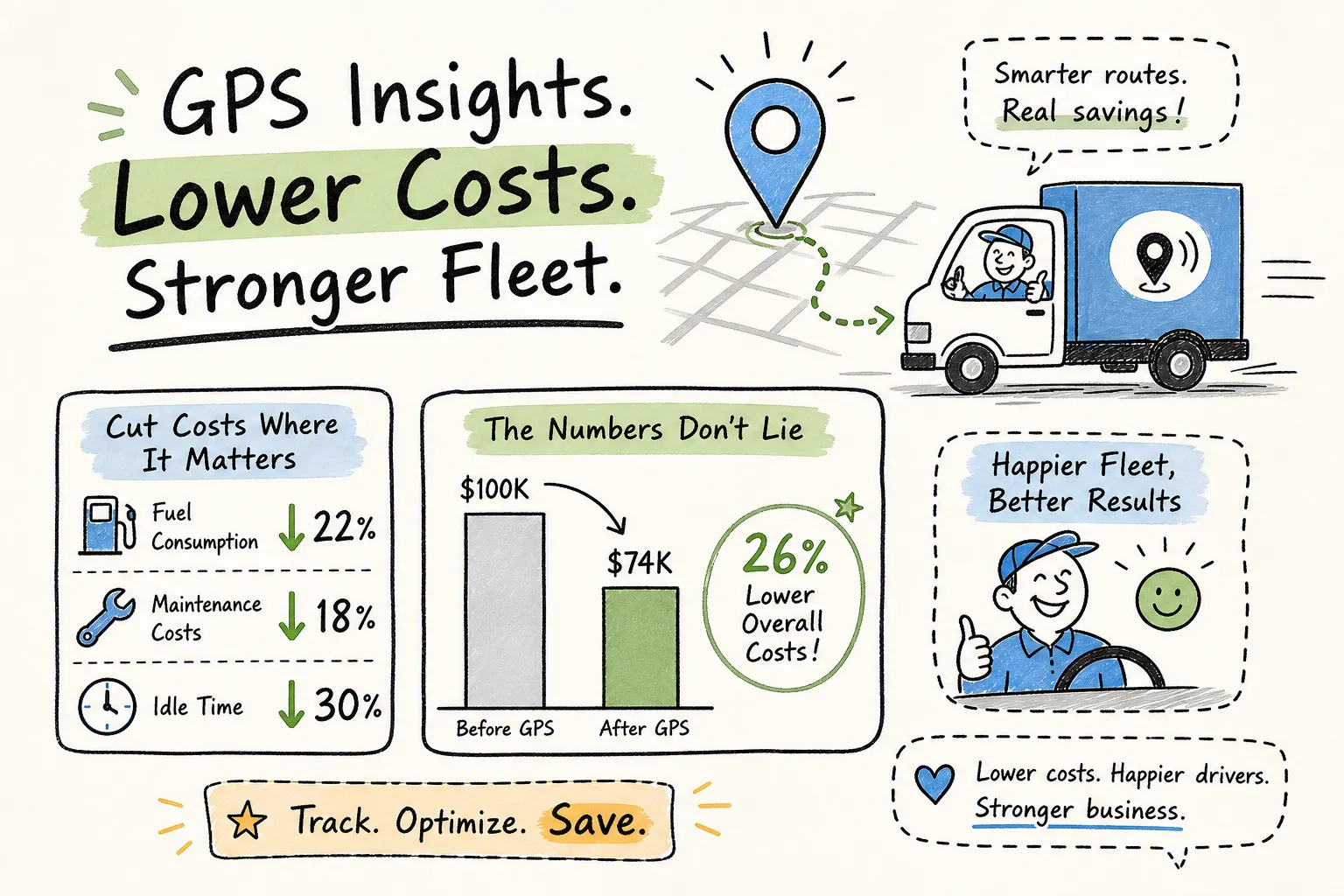
Fuel accounts for 25, 33% of a vehicle’s total operating cost. For a fleet of 20 trucks, it’s the single largest variable expense and the most recoverable. Most operators track total monthly fuel spend, but they have no visibility into where that fuel actually goes: inefficient routes, unnecessary idling, unchecked speeding, or outright theft at the pump. Tracking the total without understanding the breakdown is like watching a bank account drain without knowing which charges are hitting it.
The costs that don’t appear on an invoice are equally damaging. Reactive maintenance, unplanned downtime, and accident-related repairs don’t usually show up as a line item labeled “waste.” They arrive as emergency callouts, insurance claims, and vehicles sitting off the road for days when they should be earning. A mid-size fleet without a GPS vehicle tracking system typically bleeds money across all three of these categories simultaneously, with no way to connect those losses back to driver behavior or route data. The expenses feel random. They aren’t, and fleet management software changes that equation directly.
How GPS Reduces Fleet Costs: Fuel Savings by the Numbers
The 2025, 2026 benchmark range puts average fuel cost reduction at 12, 16% for fleets implementing standard GPS telematics. The Verizon Connect 2025 Fleet Technology Trends Report puts the average at 16%, with a range of 10, 25%. PwC’s survey of logistics firms found 12.7% for fleets using advanced tools. Research from the Australian transport sector confirmed 10, 15% within the first six months of deployment. These aren’t outliers, they’re the consistent middle of the data across multiple independent studies.
Fleets with significant existing inefficiencies, high idle time, poor routing, or unchecked speeding, land closer to 20, 25% reductions. Fleets that pair telematics with structured driver coaching and formal fuel policies have reached 20, 30%. The range isn’t random. It tracks directly with how much waste existed before the system was installed and how seriously the data gets acted on afterward.
Real-time fuel monitoring captures both behavioral inefficiency and mechanical problems early. When a truck’s fuel draw spikes outside normal parameters, the system flags it immediately. That catches aggressive driving and extended idling. It also catches fuel system leaks and injector problems before they compound into major repair bills. Fleets get actionable data per vehicle, per route, and per driver, not just a lump-sum summary at month-end that tells them nothing about where to focus. This is fuel management telematics doing exactly what it’s designed to do.
Route Optimization and Idle Time Reduction: The Fastest Wins
Route optimization reduces unnecessary mileage by up to 20%, which translates to roughly a 14.5, 30% reduction in fuel consumption annually. A 50-vehicle fleet covering typical delivery routes can recover tens of thousands of dollars per year just by eliminating redundant mileage and rerouting around traffic patterns. Initial savings typically appear within the first one to three months and build as the system refines route patterns over time.
Idling is a slow leak most operators ignore because it doesn’t look expensive at the vehicle level. It is expensive at the fleet level. A truck idling one hour per day burns roughly one gallon of diesel, an industry rule of thumb widely cited across commercial fleet operations. Multiply that across 30 vehicles and 250 working days, and you’re looking at a significant recoverable cost before you’ve touched a single other efficiency lever. Verizon Connect’s data shows a 15.9% median reduction in idle time after fleets deployed idling alerts. Real-world fleet programs have cut idling by 30, 50% in the first month when alerts are paired with driver-specific tracking and coaching.
The financial scale of verified idle reduction programs is hard to ignore. A 280-vehicle diesel fleet that reduced idle time from 52 minutes to 18 minutes per day saved $1.3 million annually. Gordon Food Service saved $2.5 million in fuel spend. These aren’t projected figures, they’re verified outcomes from structured implementations. The math holds across fleet sizes, though per-vehicle impact does vary by baseline inefficiency and sector.
Driver Behavior Monitoring and What It Does to Total Cost
Driver behavior monitoring tracks acceleration patterns, hard braking, speeding, and cornering. Feeding this data back to drivers through scorecards reduces fuel consumption by up to 10% on its own. When combined with route optimization and idle reduction, that number climbs. The key is consistency: scorecards without structured follow-up coaching produce modest results; coaching tied to measurable targets produces sustained improvement that compounds quarter over quarter.
The insurance angle is worth understanding in concrete terms. Insurers now actively reward telematics use with a two-stage discount structure. A day-one installation discount typically ranges from 5, 15%, applied simply for fitting an approved device before data collection even begins. After 6, 12 months of verified safe driving data, renewal discounts add another 5, 25%. Liberty Mutual’s Onboard Advisor program offers a 15% first-year discount that can grow to 40% as fleet safety scores improve. Progressive Commercial’s SmartHaul program offers up to 18% for fleets sharing approved ELD data. The telematics system functions as continuous evidence of risk management, and underwriters price that evidence accordingly.
Preventive Maintenance Scheduling and What It Prevents
GPS-integrated maintenance scheduling triggers service alerts based on mileage, engine hours, and real-time diagnostic codes, not arbitrary calendar intervals. Catching a failing component before it causes a breakdown eliminates the emergency callout cost, the towing bill, and the lost revenue from a vehicle sitting off the road for days instead of hours. Industry benchmarks put the maintenance cost reduction at 25, 30% for fleets that shift from reactive to predictive scheduling, with specific implementations reporting up to 35%. The U.S. Department of Energy’s operations and maintenance research confirms 25, 30% as the consistent average for structured preventive programs.
What gets caught early matters. Tire pressure monitoring tied to GPS asset tracking systems can deliver measurable fuel economy improvements, the upper end of cited ranges reaches 40% in cases of severely underinflated tires, though typical fleet gains are more modest. Engine fault code monitoring catches injector issues, cooling problems, and transmission warnings before small repairs escalate into significantly more expensive failures. For a fleet operating on thin margins, preventing two or three major engine failures per quarter more than justifies the telematics investment on its own. An 18-month case study tracking GPS-driven predictive maintenance found a 34% reduction in maintenance costs, not a projection, but a measured outcome over a real operating period.
Reduce Fleet Costs with GPS: Building a Pilot That Shows Real Numbers Fast
The fastest way to build internal buy-in for GPS fleet tracking is to run a structured 10-vehicle pilot for 90 days. Measure fuel cost per kilometer before and after. Track idle time per driver. Log maintenance work orders triggered by system alerts versus unplanned breakdowns. Three months of honest data from a controlled group is far more convincing than any vendor ROI calculator, and it shows you exactly where your fleet’s specific money is going rather than where an average fleet’s money goes.
Payback timelines by fleet size are well-documented across the industry, though actual results vary by baseline conditions and sector. Fleets in the 10, 25 vehicle range typically hit payback in 2, 4 months. Fleets in the 26, 50 vehicle range often break even in 1, 3 months as better pricing tiers kick in and routing optimization compounds. Fleets above 50 vehicles frequently see payback in weeks, not months, because scale amplifies every percentage point of fuel and maintenance savings simultaneously.
A GPS tracker alone gives you location data. An integrated fleet management software platform connects that location data to fuel consumption, maintenance records, driver performance, and route history in one dashboard. This is where cost reductions compound faster: fuel anomalies trigger maintenance checks; route data informs scheduling; driver scores connect to training records. Easy Track’s fleet ERP and fuel monitoring tools are built to deliver this compounding effect for commercial operators, the return isn’t just faster, it’s more durable because the system reinforces itself across every cost category.
The Math Is Straightforward
Fuel savings of 12, 16%, maintenance cost reductions of 25, 30%, and insurance discounts of up to 25% don’t require a massive fleet or a complex rollout. They require consistent data collection and the discipline to act on what that data shows. The fleets achieving the highest end of these ranges aren’t doing anything exotic. They’re running structured driver coaching, acting on maintenance alerts, and optimizing routes based on real traffic patterns rather than assumptions.
Start with a pilot. Pick 10 vehicles. Measure honestly for 90 days. The data will tell you exactly which cost buckets are leaking and exactly how much GPS fleet tracking closes each one. Scale what works. The blind spots that have been costing you money don’t disappear on their own, but with the right tools in place, they stop being blind spots at all. That’s what it means to reduce fleet costs with GPS: not a promise on a brochure, but a measurable outcome backed by consistent data.
If you’re ready to run those numbers on your fleet, Easy Track offers GPS vehicle tracking, fuel monitoring, and fleet ERP solutions built for commercial operators, with full support from installation through ongoing fleet optimization. The pilot doesn’t have to be complicated. It just has to start.

 By
By